Client-Side UI Integration Across Web Applications
Architecture Case Study
By Nataraj Narayana
Overview
This case study examines a real-world evaluation prototype that explored client-side UI integration across multiple independently deployed web applications, backed by a shared monolithic backend.
The system was originally built to understand how frontend autonomy, loose coupling, and incremental modernization could be achieved without backend ownership — under real organizational and technical constraints.
Rather than judging the architecture by modern standards alone, this case study focuses on:
- Why the architecture made sense at the time
- What trade-offs were consciously accepted
- How the same problem would be approached today
Problem Context
Enterprise web applications have historically evolved as tightly integrated systems.
As frontend complexity grew, teams faced increasing challenges around:
- Independent deployments
- Technology heterogeneity
- Coordinated frontend changes
- Backend ownership constraints
This prototype explored whether browser-native integration mechanisms could be used to decompose a UI while preserving a cohesive user experience.
Key Architectural Themes
- Frontend autonomy without micro-frontend frameworks
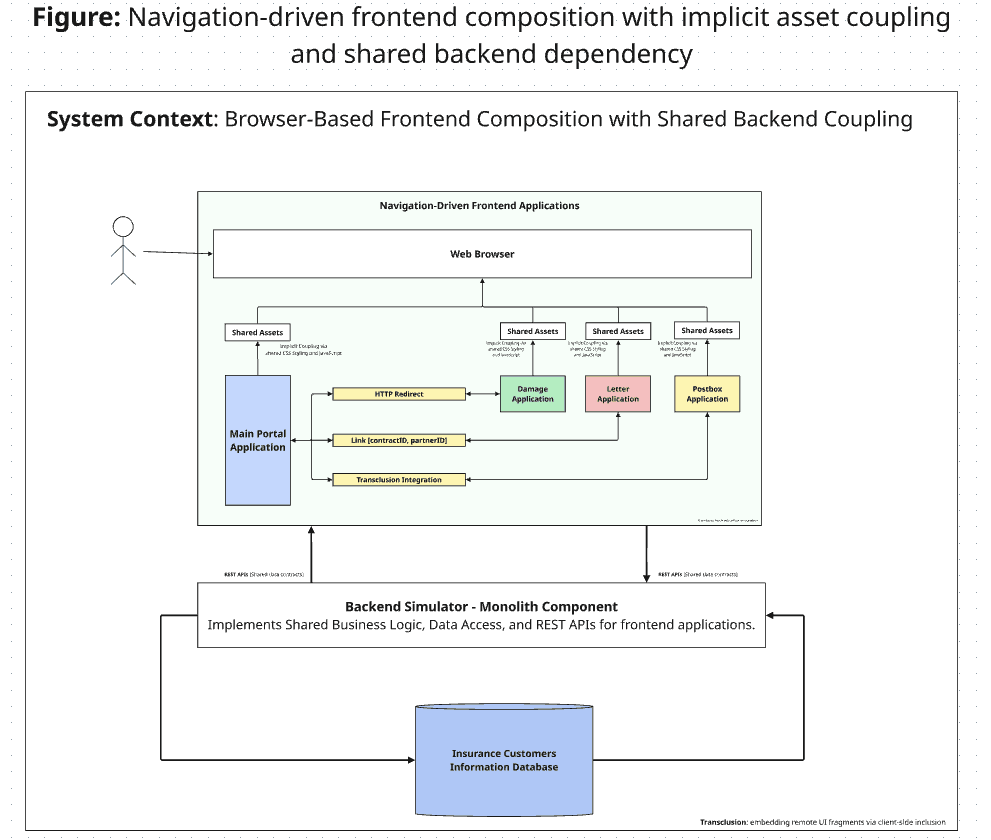
- Navigation-based composition (links, redirects, transclusion)
- Loose frontend coupling with deliberate backend coupling
- Graceful degradation and resilience
- Organizational constraints shaping architecture
System Context (Evaluation Prototype)
Below is the system context diagram representing the original evaluation architecture.
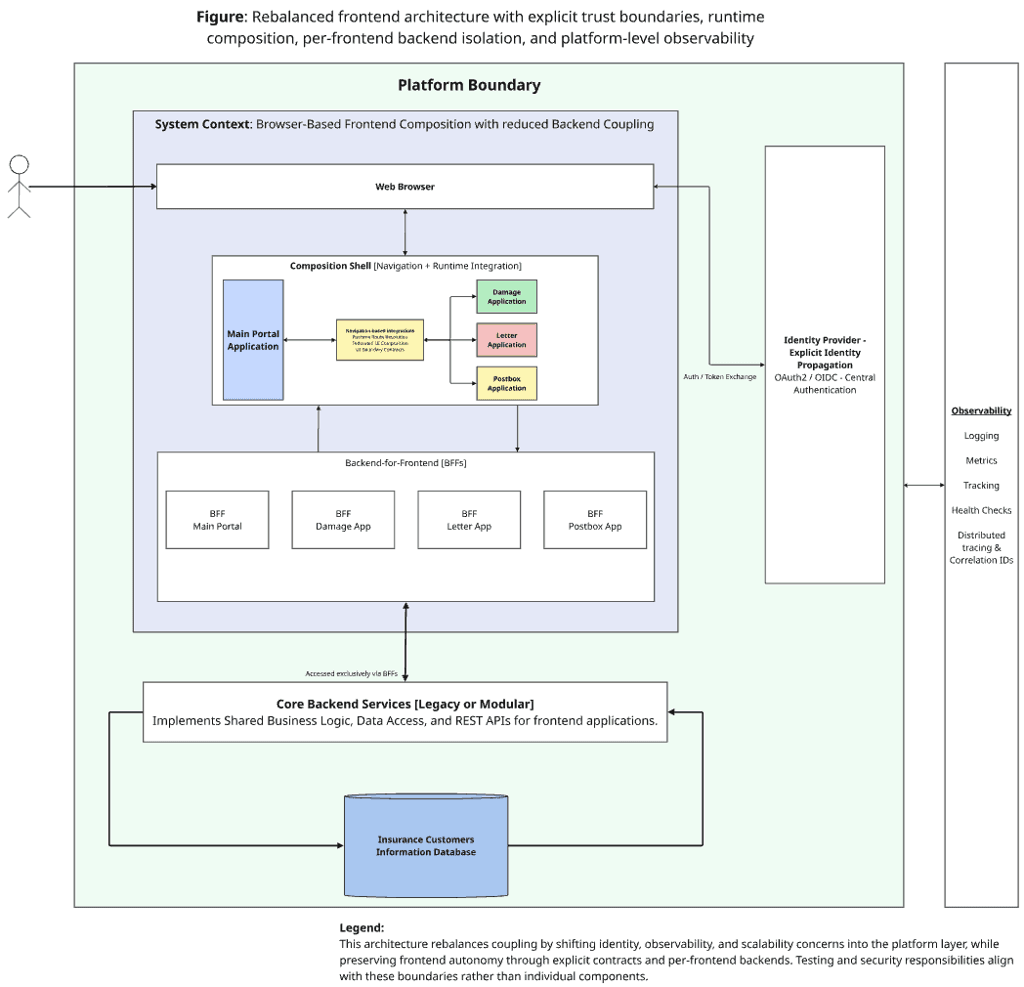
Modernized View (Conceptual)
If the same problem were approached today, modern platforms and patterns would rebalance several trade-offs while preserving the original intent.
Read the Full Case Study
The complete case study covers:
- Integration mechanisms in depth
- Trade-offs and long-term consequences
- Security, identity, and trust boundaries
- Observability, testing, scalability, and cloud deployment
- A modern reinterpretation of the architecture
Download the full case study (PDF):
Download the full case study (PDF)
Closing Note
This case study is not about frontend frameworks.
It is about architectural maturity:
- Understanding constraints
- Making conscious trade-offs
- Knowing when not to change
Modern tools evolve — architectural thinking endures.